
GEO by AI engine: one visibility strategy doesn’t fit all.
An original, practical guide to how brands should think about visibility across ChatGPT, Claude, Gemini and Perplexity.
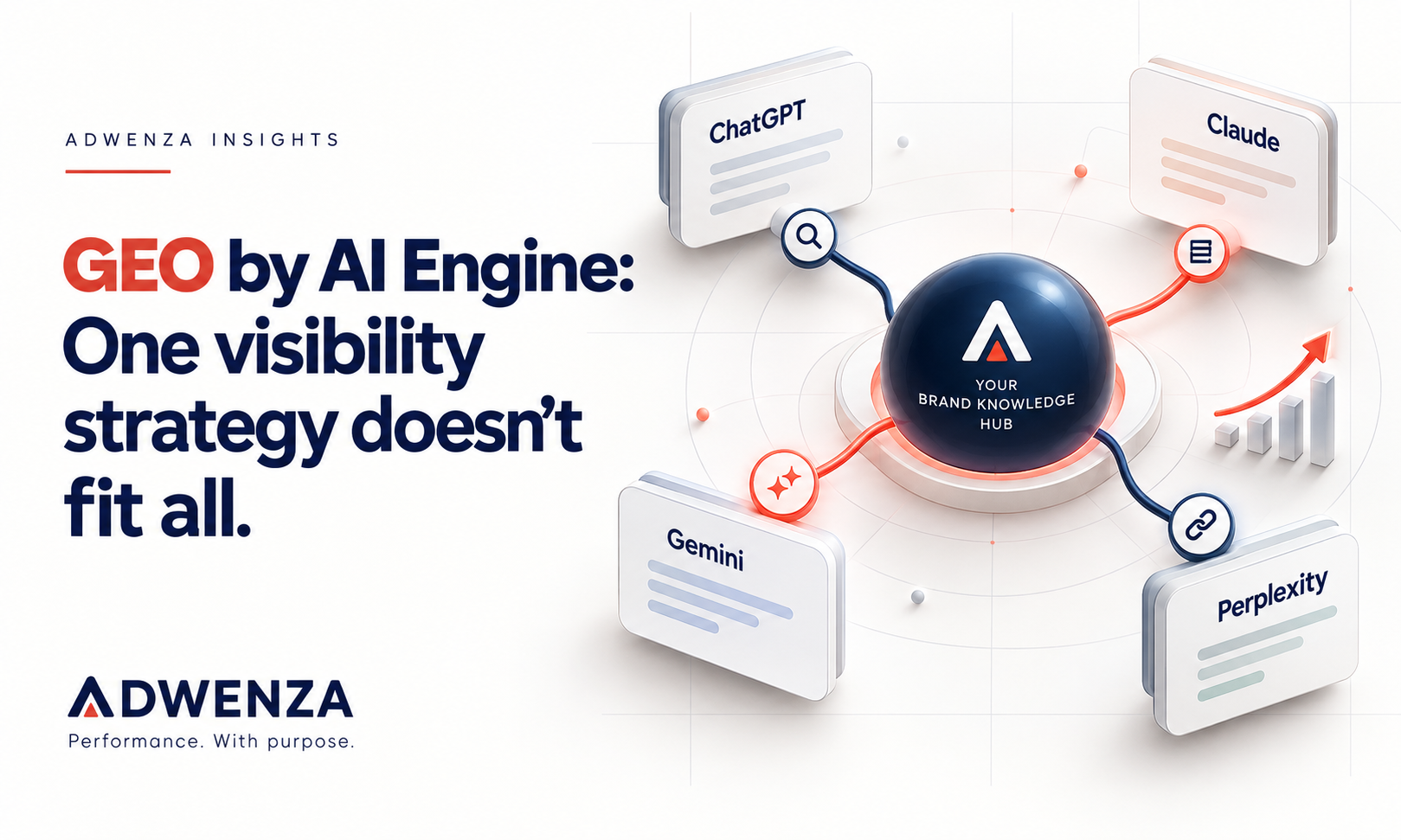
People no longer discover brands through one results page alone. They ask conversational questions, compare recommendations and expect a useful answer immediately. But the major AI products do not retrieve, compose or present information in exactly the same way.
No outsider knows each platform’s complete, current selection formula. The responsible approach is to work from observable product behaviour, official documentation where available, and repeated prompt testing—then revisit assumptions as the systems change.
The shared foundation behind AI visibility
Every engine needs material it can understand and trust. That starts with crawlable pages, explicit brand and service definitions, evidence for important claims, consistent company details and content that answers a complete question without forcing the reader to assemble the answer from several pages.
GEO does not replace SEO. Technical accessibility, internal linking, authority and a useful information architecture remain the base layer. The difference is that success may appear as a mention, summary or citation—not only a blue-link visit.
What changes across the four engines
Create complete explainers that can also support narrower questions. Keep definitions, comparisons and action steps easy to extract.
Publish well-organised, nuanced material with a clear point of view, limitations and evidence that survives deeper analysis.
Strengthen entity consistency, structured data and the connection between your website, business profiles, video and other Google-visible assets.
Make factual claims attributable, keep important pages current and support useful statements with original or authoritative sources.
A platform-aware GEO action matrix
| Engine | Content priority | Proof priority | Review signal |
|---|---|---|---|
| ChatGPT | Explainers, comparisons, FAQs | Clear claims and examples | Brand inclusion across follow-up prompts |
| Claude | Deep guides and frameworks | Reasoned argument and limitations | Accuracy and depth of brand description |
| Gemini | Entity-rich service content | Schema and ecosystem consistency | Correct entity and offering recognition |
| Perplexity | Fresh, source-ready answers | Citations and original evidence | Source citation frequency and placement |
Build content that can become an answer
Start from real customer prompts rather than isolated keywords. Give each page a clear question, a direct answer, supporting explanation, proof, examples and an obvious next step. Use descriptive headings so a person—or retrieval system—can understand the page without guessing.
Question → Direct answer → Evidence → Example → Limitations → Next action.
Original data, expert commentary, transparent methodology and first-hand experience are difficult to replace with generic summaries. They also give other publishers a reason to mention and cite your brand.
Measure more than rankings
AI visibility is variable: answers can change by wording, location, product mode and time. Use a fixed prompt set, run it consistently and record what appears rather than relying on one impressive screenshot.
A practical 90-day starting plan
Define priority prompts, capture current visibility, fix entity inconsistencies and identify pages with weak answers.
Upgrade core service pages, publish source-ready answers and add structured data where it accurately describes the content.
Develop original evidence and pursue relevant third-party mentions that confirm expertise beyond your own domain.
Repeat the prompt set, compare mentions and citations, diagnose gaps and choose the next content cycle.
GEO by engine FAQs
Do all AI engines use the same ranking system?
No. They share some underlying model concepts, but their retrieval, product design, available data and response presentation differ.
Should we create four versions of every article?
Usually no. Build one authoritative source, then make sure its structure, evidence, entities and freshness support the platforms most important to your audience.
Can GEO performance be guaranteed?
No. These systems are proprietary and change frequently. GEO should be managed as measured experimentation, not guaranteed placement.
What should a business improve first?
Start with accurate entity information and pages that directly answer the commercial questions customers already ask.
Optimise the information system, then learn how each engine uses it.
A durable GEO strategy is not four sets of tricks. It is one credible brand knowledge base, tested across four different discovery experiences.
Want to understand your AI visibility?
Bring your priority services, customer questions and current content to a focused GEO conversation.
This is original educational content from Adwenza. It does not reproduce the referenced Neil Patel article. AI products and retrieval behaviour change frequently; validate important assumptions against current platform documentation and observed results.